
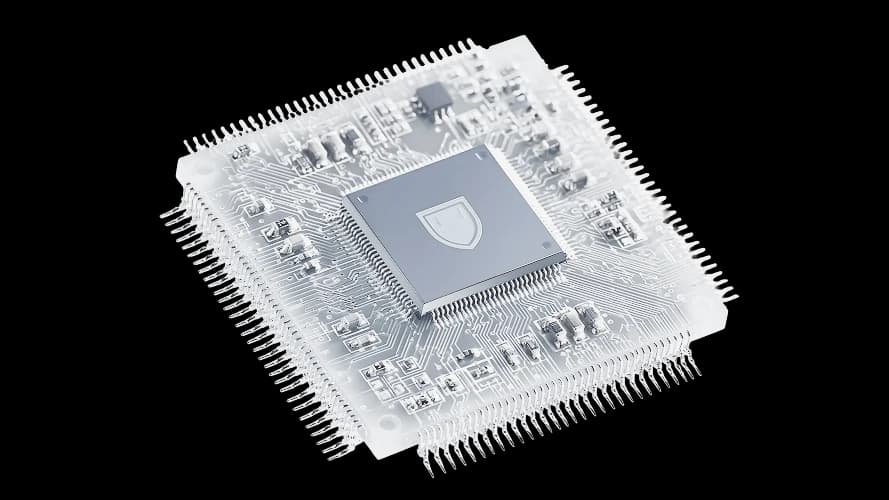
Quantum Compute-In Memory
QCIM is a soft IP cryptographic accelerator architecture that combines symmetric and asymmetric encryption engines into a compact, low-power block optimized for both classical and post-quantum cryptography (PQC). Designed for integration across a variety of process nodes, QCIM redefines secure element performance with cryptographic compute-in-memory (CIM) capabilities, crypto agility, and unmatched efficiency.
Key Features
Key Features
- Crypto-Agile & Reprogrammable
- The world's smallest reprogrammable, crypto-agile cryptographic accelerator. Seamlessly supports traditional algorithms like AES and ECDSA, and post-quantum standards including ML-KEM and ML-DSA.
- Soft IP for Seamless Integration
- Delivered as synthesizable soft IP, compatible with leading foundry nodes (TSMC, GF, and more) and off-the-shelf SRAM macros. Adaptable across process nodes for ASIC or FPGA deployment.
- Minimal Area Footprint
- Delivered as synthesizable soft IP, compatible with leading foundry nodes and off-the-shelf SRAM macros. Adaptable across process nodes for ASIC or FPGA deployment.
- Compute-In-Memory (CIM)
- Cryptographic operations are executed inside the memory subsystem, reducing latency, power consumption, and data movement.
- Ultra-Low Power
- Sub-microjoule energy usage per cryptographic operation. Ideal for constrained environments like smart cards, wearables, and edge devices.
Why QCIM?
Side-Channel Secure & Crypto Agile
QCIM's design makes it upgradable with new classical, post-quantum, and upcoming algorithms after deployment, with side-channel protection.

Smaller, Faster, Lower Power
Optimized for low power and small die area. QCIM bundles all deployed algorithms in the same IP block, creating a record low crypto engine footprint.
Soft IP & Standalone Chips
Whether you're building secure ASIC's, FPGA devices, or need a standalone RoT, QCIM adapts to your needs and roadmap.
Performance Benchmarks
AES Acceleration
Outperforms leading crypto coprocessors with ~5x faster parallel execution.
SHA-3 Throughput
Achieves 6 cycles/byte in parallel mode, offering high-speed hashing with minimal power.
ECDSA P-256
Sustains 1M signing ops/sec, with base point randomization included.
Supported Cryptographic Algorithm
| Algorithm | Key Sizes & Modes | Operations |
|---|---|---|
| ML-KEM | 512 · 768 · 1024 | Keygen / Encaps / Decaps |
| ML-DSA | 44 · 65 · 87 | Keygen / Sign / Verify |
| AES | Modes - ECB, CTR, CBC, GCM128 · 192 · 256 | Encryption |
| SHA-3 | 256 · 384 · 512 | Hashing |
| SHAKE | 128 · 256 | Hashing |
| ECDSA | P-256 | Keygen/Sign/Verify |
| Upcoming Algorithms | ||
| HAETAE | 2 · 3 · 5 | Keygen/Sign/Verify |
| HQC | 128 · 192 · 256 | Keygen/Encaps/Decaps |
Applications
QCIM enables quantum-secure cryptographic acceleration across diverse applications, from smart cards to enterprise systems.
Smart Cards
Ultra-compact, low-power cryptographic acceleration for next-generation payment, identity, and access smart cards — ready for a post-quantum world.
Secure Elements
Drop-in crypto agility for mobile devices, embedded systems, and payment terminals. Reprogrammable to evolve with future standards.
Edge IoT Devices
High-speed, low-latency security at the network edge. QCIM extends battery life and delivers quantum-secure communications for billions of connected devices.
Hardware Wallets
Bulletproof private key protection in a tiny footprint. QCIM brings quantum resistance to wallets without compromising speed or portability.
Post-Quantum PKI
Hardware-accelerated key generation, signing, and encryption for enterprise and government PKI systems migrating to post-quantum security.
Inquire about QCIM
Fill out form, and a member of our team will connect with you soon. Your journey into the future of quantum secure technology starts here.
General Inquiries
desk@btq.com
Investor Relations
investors@btq.com